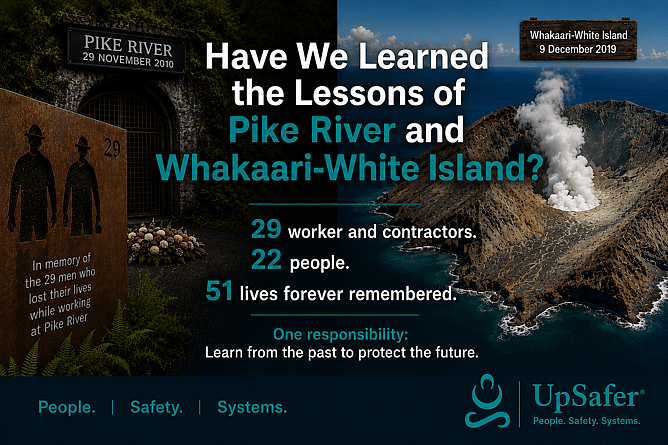
Have We Learned the Lessons of Pike River and Whakaari-White Island?
Before we debate legislation, regulations or compliance, we should remember one simple truth: behind every health and safety law are real people whose lives were lost, and families who continue to live with that loss. Every amendment we consider should be measured against one question—will it better protect people and help prevent another tragedy?
New Zealand's health and safety Work Act has been shaped by two tragic events that changed our country forever.
The Pike River Coal Mine Tragedy claimed the lives of 29 workers. The Royal Commission into the Pike River Coal Mine Tragedy identified serious failures in governance, risk management, leadership, and regulatory oversight. Those findings became a major influence on the development of the Health and Safety at Work Act 2015.
Nine years later, the Whakaari-White Island eruption claimed the lives of 22 people and left many others with life-changing injuries. The disaster reinforced another critical lesson: organisations must understand and manage critical risks, directors and officers must exercise effective due diligence, and worker safety cannot be compromised.
Today, New Zealand is considering proposed amendments to the Health and Safety at Work Act.
Reducing unnecessary compliance and making the legislation easier to apply can benefit businesses. However, any reform should be measured against one important question:
Will these changes strengthen—or weaken—our ability to prevent another Pike River or Whakaari-White Island?
What makes this question even more important is that New Zealand still has one of the poorer workplace safety records among comparable developed nations. Despite the introduction of the HSWA 2015, our workplace fatality rate remains higher than that of the United States and many other OECD countries. This tells us that while legislation is important, legislation alone is not enough. Real improvement comes from leadership, culture, accountability, and effective management of critical risks.
Health and safety has never been about creating more paperwork.
It is about strong leadership, effective governance, meaningful worker engagement, and managing the risks that have the potential to cause serious harm or loss of life.
Behind every workplace fatality is a family whose lives are changed forever.
How do we tell a husband, wife, partner, parent, child or friend that their loved one is not coming home?
That is the reality behind every statistic. It is a conversation that no family should ever have to experience.
As professionals, business leaders, and PCBUs, we have a responsibility to ensure that improvements to legislation do not come at the expense of the lessons that were learned through tragedy.
Before changing the law, we should ask ourselves:
If Pike River happened tomorrow, or another Whakaari-White Island occurred, would these proposed amendments better protect workers—or would they leave us asking the same questions again?
That is the conversation New Zealand should be having.
The goal should not simply be less regulation.
The goal should be safer workplaces, better leadership, and stronger risk management for every worker in New Zealand.
Because at the end of every working day, every person deserves to go home safely to the people who love them.
People. Safety. Systems.
In respectful memory of the 29 workers who lost their lives at Pike River and the 22 people who lost their lives at Whakaari-White Island. We honour their memory, acknowledge the families, friends and communities forever affected, and remain committed to ensuring the lessons learned continue to guide safer workplaces across New Zealand.
https://www.upsafer.co.nz
#HealthandSafety #HSWA #PikeRiver #Whakaari #WhiteIsland #SafetyLeadership #Governance #CriticalRisk #ISO45001 #UpSafere content here